Macula of the Eye: Importance, Structure, & Function
- By Centre For Sight
- 7 minutes
Blog Summary
Our eyes are incredible windows to the world, helping us see colours, shapes, & details every day. But have you ever wondered how we can read tiny letters, recognise faces, or enjoy a beautiful sunset so clearly? A small, crucial part of our eye called the macula makes this possible. Though it's tiny, it plays a huge role in clear central vision.
- The macula is the part of your eye that gives you sharp, detailed central vision. This type of vision is necessary for daily tasks like reading & facial recognition. In order for the brain to function, focused light is converted into signals.
- Macula damage can impair central vision while side (peripheral) vision remains unaffected.
- Early diagnosis & treatment are important to slow down the vision loss.
What Is the Macula of the Eye?
The macula of the eye is a critical region that is located at the centre of the retina. It is responsible for central vision. This small, slightly oval, light-sensitive region measures about 5 millimetres in diameter. Its medical name, macula lutea, comes from Latin, where 'macula' means 'spot' & 'lutea' means 'yellow.' Together they translate as 'yellow spot.' 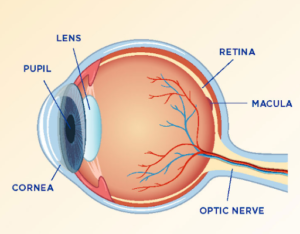
Structure of the Macula
The structure of the macula is complex & includes parts like fovea, foveola, & photoreceptor cells. 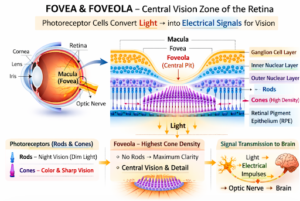
Fovea & Foveola
The macula contains a dedicated region called the fovea centralis. It is a concave area densely populated with cone photoreceptors that mediate the highest visual acuity. The exceptionally high concentration of cone cells in the fovea allows for precise vision. At its very middle is an even smaller region known as the foveola. It is the thinnest part of the retina & contains only one photoreceptor cone cell. There are virtually no rods. The central fovea has many compact cones. They are rod-like in appearance & thinner than other cones. These cones are packed densely in a hexagonal pattern. It starts at the fovea's outskirts. Here, rods gradually appear & the cone receptor density progressively declines.
Photoreceptor cells
A crucial part of the macula anatomy is the photoreceptor cells. Like the rest of the retina, the macula is mainly made of these special cells. They absorb light & change it into electrical signals. These signals travel through the optic nerve to reach the brain. Then they are interpreted, enabling clear vision. 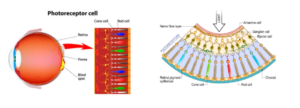 There are two main types of photoreceptors:-
Rod cells
Rods are specific photoreceptor cells that sense the brightness or intensity of light. They are essential for vision in dim lighting & play a key role in night vision.
Cone Cells
The macula contains a large number of cone cells. Hence, allows us to see sharp details clearly. It also helps in distinguishing colours. They work together to give you a clear & accurate view of your surroundings.
Macula Function: Why It Is So Important?
The macula supports several essential visual functions:
- Sharp central vision
- Colour perception
- Fine detail recognition
- Depth and contrast sensitivity
When light enters the eye, it first passes through the cornea. It then moves through the lens. The most focused light falls on the macula. Like the rest of the retina, the macula functions & changes light into electrical signals.? These signals travel through the optic nerve to the brain, where they are clearly seen what is directly in front. 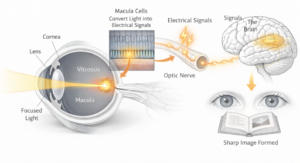 For example:-
- When you read, your eyes position the words & they fall onto the macula.?
- When you look at someone's face, the macula helps you see small details & expressions. It provides the clarity and precision needed for focused tasks.
Common Problems That Affect the Macula of the Eye
1. Age-Related Macular Degeneration (AMD)
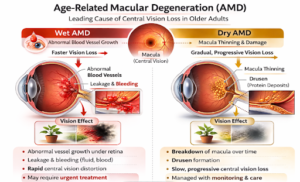 AMD is one of the most common causes of vision loss in older adults. There are two main types:
- Dry AMD (Atrophic)
Involves the gradual thinning of macular tissue. It usually develops gradually & may cause a slow decline in vision over time.
- Wet AMD (Neovascular)
Abnormal blood vessels grow under the retina. It causes more rapid vision changes & may require urgent treatment.?
2. Macular Edema
Macular Edema refers to swelling in the macula due to fluid buildup. It is often associated with:
- Diabetes, especially diabetic retinopathy
- Retinal vein occlusion
- Eye inflammation
Swelling interferes with normal retinal function & can cause blurry or distorted central vision.
3. Macular Hole
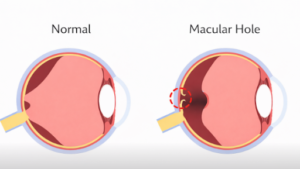 A macular hole is a small tear in the macula. It can develop due to age-related changes in the vitreous gel that pulls on the retina. Symptoms may include:
- Blurred central vision
- A dark or empty spot in the centre of vision
- Distorted straight lines
Early surgical intervention may help improve outcomes.
4. Macular Pucker (Epiretinal Membrane)
Macular pucker is an eye condition in which a thin layer of scar tissue forms over the macula. When scar tissue develops on its surface, it can wrinkle or distort the macula. This leads to blurred or distorted central vision. The symptoms include:-
- Blurred central vision
- Straight lines appear wavy (distorted vision)
- Difficulty reading small print
- Trouble recognising faces
- A grey or cloudy area in central vision
Peripheral (side) vision is usually not affected. Other Macula-related problems include:-
- Branch retinal vein occlusion
- Central retinal vein occlusion
- Central serous retinopathy
- Choroidal neovascular membranes
- Cytomegalovirus retinitis
- Histoplasmosis
- Macular degeneration
- Stargardt Disease
- Central Serous Retinopathy, & many more.
Symptoms of Macula Damage
Macular disorders often share similar symptoms. These may include:
- Blurry central vision
- Distorted lines, also called metamorphopsia
- Difficulty reading small print
- Dark or empty areas in central vision
- Colours appearing faded
In the early stages, the peripheral (side) vision usually stays normal. You may feel your eyesight is fine at first, but then the situation worsens. If you notice sudden blur or wavy vision in the centre, see an eye specialist as soon as possible!
Causes & Risk Factors Affecting the Macula of the Eye
Some risk factors cannot be changed, such as age or genetics. However, the following are some of the causes & risk factors of the macula of the eye:-
- Ageing
- Diabetes
- High blood pressure
- Smoking
- Family history
- Excessive UV exposure
Diagnosis of Macular Disorders
Early diagnosis often allows better treatment options. An eye specialist, usually an ophthalmologist, can evaluate the macula using several tools. These may include:
- Dilated eye examination
- Optical coherence tomography, also called OCT
- Fundus photography
- Fluorescein angiography in certain cases
Please Note:- OCT is particularly helpful. It provides detailed cross-sectional images of the retina & allows doctors to detect swelling, thinning, or structural damage.
Treatment Options for Macular Disorder
- Anti-VEGF injections (for wet AMD)
These injections are used to treat wet age-related macular degeneration. They help reduce abnormal blood vessel growth & leakage. which can slow vision loss.
- Laser therapy - Laser treatment can be used to seal leaking blood vessels or treat certain retinal problems.
- Vitrectomy (for macular hole)? - It is a surgical procedure used to repair a macular hole. This treatment involves removing the vitreous gel inside the eye to relieve pressure on the macula.
Lifestyle changes Make sure to do a lifestyle change. For this, you need to:-
- Check your blood sugar
- Manage Blood Pressure
- Avoid Smoking
Ensuring regular eye checkups helps protect macular health & allows early detection of problems.
- Nutritional supplements (AREDS formula) - Some people with age-related macular degeneration may benefit from specific vitamin & mineral supplements based on the AREDS formula. These supplements can help slow disease progression in certain cases.
Prevention & Eye Care Tips
- Get regular eye checkups, especially after age 40
- Eat a healthy diet (leafy greens, fruits, omega-3-rich foods)
- Control diabetes & blood pressure
- Wear UV-protective sunglasses outdoors
- Avoid smoking
When to see an eye specialist?
You should consult an eye specialist if you notice:
- Sudden central vision distortion
- Rapid vision loss
- Persistent blurriness
- A dark spot in the centre of your vision
Early treatment of wet macular degeneration or macular edema can significantly slow progression. Delaying care may limit treatment options!
Frequently Asked Questions
Where is the macula located in the eye?
Why is the macula important for vision?
What happens if the macula is damaged?
What are the early signs of macular degeneration?
Who is at risk of developing macular problems?
How are macular disorders diagnosed at Centre for Sight?
Can macular damage be treated or reversed?
What is the difference between the macula and the retina?
What lifestyle changes help keep the macula healthy?
At what age do macular problems usually begin?




Could not find what you are looking for?


