
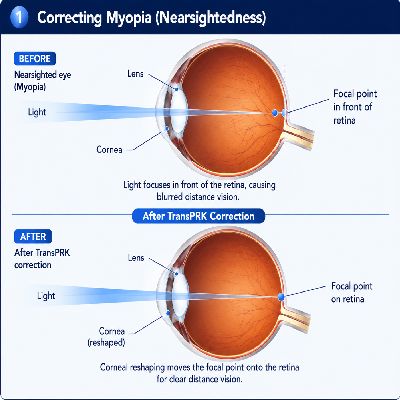
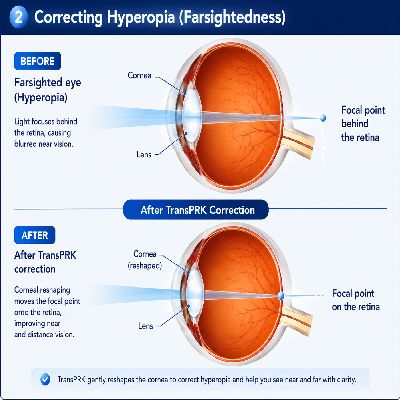
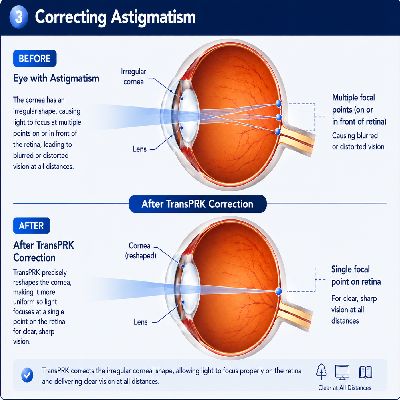
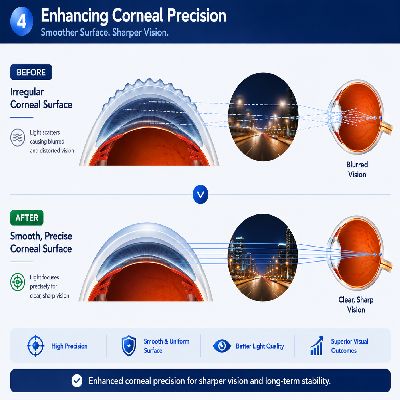








Trans PRK is a modern, bladeless and flap-free laser vision correction procedure that reshapes the cornea to treat common refractive errors such as nearsightedness (myopia), farsightedness (hyperopia), and astigmatism. Unlike LASIK, it does not create a corneal flap, so it avoids flap-related risks and can be a good option for people with thinner corneas or active lifestyles.

Recovery is slower and more uncomfortable in the first few days compared with LASIK or SMILE, because the eye’s surface layer needs time to heal. Vision gradually sharpens over the following weeks, with full stabilization taking longer in some patients. 

Discover how Trans PRK surgery can improve your eyesight by exploring this page.

What Is Trans PRK Eye Surgery?

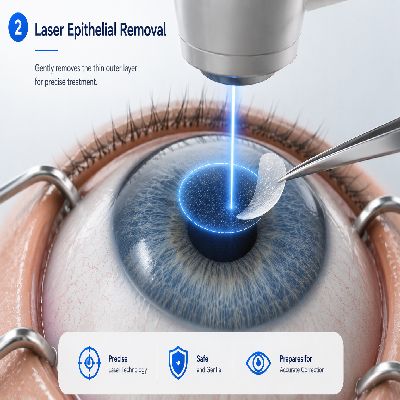
Trans PRK (Transepithelial Photorefractive Keratectomy) is a laser vision correction representing a significant leap forward in ophthalmic technology. Unlike traditional PRK, where the epithelial layer of the cornea is manually removed, Trans PRK uses a laser to perform this step with remarkable precision. This method is less invasive and can result in a more comfortable experience for the patient, minimizing discomfort and reducing trans prk recovery time. The procedure aims to reshape the cornea to correct refractive errors such as myopia (nearsightedness), hyperopia (farsightedness), and astigmatism. By doing so, it enhances the focusing power of the eye, leading to clearer vision. Additionally, the laser’s precision allows for a more tailored approach, accommodating the unique curvature and thickness of each patient’s cornea, which can lead to even better visual outcomes.

Who Is an Ideal Candidate for Trans PRK Surgery?

Ideal candidates for Trans PRK Eye Surgery are individuals with thin corneas or those who have previously undergone corneal surgery, making them unsuitable for LASIK surgery. It is also a viable option for patients with active lifestyles or occupations that pose a higher risk of eye injury, as there is no flap that could be dislodged. This makes it an excellent choice for athletes, military personnel, or anyone involved in physically demanding activities. Candidates should be over 18 years old, have a stable prescription for at least one year, and be free from any eye diseases or conditions that could affect healing.

  1. You are 18 years or older
  2. You have had no notable changes in your vision prescription for at least 1 year
  3. You suffer from mild to moderate vision problems, such as near-sightedness, farsightedness, or astigmatism
  4. You are free from autoimmune disorders or medical conditions like diabetes
  5. Your eyes are healthy and free from infection, scars, or corneal conditions like keratoconus
  6. You do not suffer from severe dry eye
  7. You prefer a minimally invasive, bladeless, flap-free laser treatment that avoids flap-related risks, though healing is slower and early discomfort is higher than LASIK or SMILE, with vision improving gradually over the following weeks.

If you fit any of these requirements, Trans PRK could be an effective option to improve your vision.

The Trans PRK Procedure: What to Expect

Pre-Procedure:

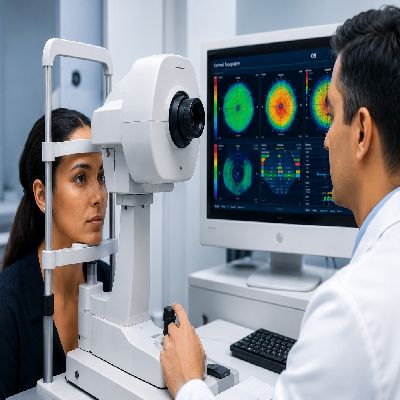
Patients undergo an eye exam to confirm suitability, including corneal measurements, to ensure the best possible outcome. This thorough assessment helps tailor the procedure to each individual’s unique eye structure. On the procedure day, numbing drops are applied for comfort, and a speculum keeps the eye open, ensuring the patient remains relaxed and still.

During the Procedure:

A laser precisely removes the corneal epithelial layer, followed by an excimer laser reshaping the cornea to correct vision. This advanced technology allows for exceptional accuracy, enhancing the overall effectiveness of the surgery. The process takes about 10 to 15 minutes per eye, making it a quick and efficient procedure.

Post-Procedure:

A protective lens is placed on the eye to shield it during the initial healing phase. Patients should rest, avoid strenuous activities, and use prescribed drops to aid healing, which is crucial for optimal recovery. Follow-up visits ensure proper recovery, with vision gradually improving as the eye heals and adjusts.

Benefits of Trans PRK Surgery

  • Enhanced safety and precision due to the laser’s accuracy in removing the epithelial layer, leading to fewer complications.
  • Smoother recovery process, allowing patients to return to normal activities more quickly.
  • Absence of a corneal flap reduces the risk of flap-related issues, making it a safer option for:
    • Patients with certain eye conditions.
    • Individuals involved in contact sports or high-risk activities.
  • Long-lasting results that significantly enhance the quality of life for individuals with refractive errors.
  • Suitable for patients with thin corneas or those who have undergone previous corneal surgeries.
  • Reduced postoperative discomfort compared to traditional methods.
  • Lower risk of infection and scarring due to the non-invasive nature of the procedure.
  • Improved visual outcomes, providing clearer and sharper vision.
  • Ideal for individuals with active lifestyles, as there is no risk of flap dislodgement.

What Is the Recovery Process After Trans PRK Surgery?

Recovery from Trans PRK Surgery typically involves a few days of discomfort and blurred vision. Patients are advised to rest their eyes and avoid strenuous activities during this period. It is essential to use prescribed eye drops to prevent infection and aid in healing.

Wearing sunglasses can help protect the eyes from bright light and UV exposure. Follow-up appointments with the eye specialist are crucial to monitor the healing process and ensure optimal results. Most patients can resume normal activities within a week.

What Are the Risks of Trans PRK Surgery?

As with any surgical procedure, there are Trans PRK side effects and risks too.

Risks:

  1. Burning, itching, or soreness
  2. Delayed visual recovery
  3. Dry eyes
  4. Glare or halos around dim lights, especially at night
  5. Under-correction or over-correction
  6. Infection or inflammation
  7. Corneal haze
  8. Light sensitivity
  9. Scarring or vision loss

What Side Effects Can Occur After Trans PRK Surgery?

Patients may experience pain, burning, or itching in their eyes following Trans PRK surgery, particularly during the first few days. Common side effects include dryness of the eyes, glare, halos, and sensitivity to light. Visual improvement occurs gradually, and patients should carefully adhere to their doctor’s care instructions.

How Is Trans PRK Different from LASIK, SMILE, and PRK?

Trans PRK differs from LASIK, SMILE, and traditional PRK in several ways. Unlike LASIK, Trans PRK does not involve creating a corneal flap, which eliminates the risk of flap-related complications. SMILE, another flapless procedure, involves creating a small incision, whereas Trans PRK uses a laser to remove the epithelial layer.

Compared to traditional PRK, Trans PRK offers a more comfortable experience and quicker recovery due to the laser’s precision. Each procedure has its own set of advantages and is suitable for different patient needs. A consultation with an eye specialist will help determine the best option.

What Is the Cost of Trans PRK Surgery in India?

The cost of Trans PRK Surgery can vary depending on several factors, including the clinic, surgeon’s experience, and geographic location. At Centre For Sight, it starts from 75,000 for both eyes. While this is a significant investment, the long-term benefits of improved vision and reduced dependence on corrective lenses are invaluable.

Many clinics offer financing options to make the procedure more accessible. It is essential to discuss the costs and available payment plans during the consultation to make an informed decision.

Why Choose Centre For Sight for Trans PRK Surgery?

Centre For Sight is a leading provider of advanced eye care services, including Trans PRK Surgery. With a team of highly skilled and experienced ophthalmologists, the centre is dedicated to delivering exceptional patient care and achieving outstanding surgical outcomes.

State-of-the-art technology and a patient-centric approach ensure that each individual receives personalized treatment tailored to their unique needs. Choosing Centre For Sight guarantees a commitment to excellence and a journey towards clearer vision.

How to Book a Consultation for Trans PRK Surgery?

To begin your journey to improved vision, book a consultation with our expert team. Our specialists are ready to assess your needs and guide you through the process. For more information or to schedule your consultation, please contact us at:

Don’t wait any longer to achieve the vision you deserve. Call us or visit our website to schedule your appointment and take the first step towards a brighter future.

Frequently Asked Questions (FAQs)

How long does Trans PRK surgery take?

The laser procedure itself takes about 30–60 seconds per eye, with the entire process completing in 10–15 minutes.

No, the procedure is painless due to numbing eye drops, but mild discomfort or irritation may occur during recovery.

Most patients resume work within 5–7 days, depending on healing and visual clarity.

Initial improvement is noticeable within a few days, but full vision stabilization may take 3–6 months.

It depends. Trans PRK is flapless, making it ideal for thin corneas and active lifestyles, but LASIK offers faster recovery.

Avoid rubbing your eyes, swimming, makeup, and bright screens for a few days. Use prescribed eye drops and wear UV-protective sunglasses.It depends. Trans PRK is flapless, making it ideal for thin corneas and active lifestyles, but LASIK offers faster recovery.

Yes, both eyes are usually treated in one session for convenience.

Most insurance plans do not cover it, as it’s considered an elective procedure, but some employer benefits or financing options may help.

Long-term risks are rare. Some may experience temporary dry eyes, glare, or halos, which usually resolve over time.

Trans PRK Surgery

Trans PRK (Transepithelial PRK)