Implantable Collamer Lens Surgery (ICL): Procedure, Cost and Benefits
- By Centre For Sight
- 5 minutes
Blog Summary
ICL surgery places a biocompatible lens inside the eye to correct high refractive errors without altering the cornea, offering clearer vision, quick recovery, and a reversible alternative to traditional laser procedures.
- ICL provides vision correction without removing corneal tissue, preserving natural eye structure.
- The biocompatible collamer lens ensures long-term comfort with minimal risk of eye irritation.
- Surgery benefits people unsuitable for LASIK, especially those with thin or irregular corneas.
- Recovery is fast, with many patients experiencing noticeably sharper vision within one day.
- Although costlier than LASIK, ICL offers reversibility and excellent results for high prescriptions.
A Collamer lens is a specialised implant that combines collagen and plastic, offering a more natural, flexible option for vision correction. These lenses are lightweight and hydrophilic, meaning they easily absorb and mix with water, which enhances comfort. Their structure allows for the natural passage of gas and nutrients, promoting eye health.
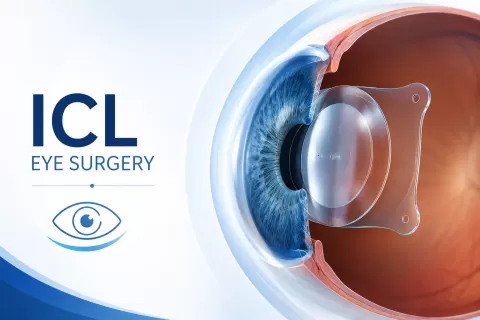
During the implantation procedure, the lens is carefully positioned behind the iris and in front of the eye's natural lens. Traditional versions of this lens required an additional step called laser iridotomy, where tiny holes were created in the iris to manage fluid pressure and ensure proper drainage after the lens was placed.
However, the newer Implantable Collamer Lens has a built-in central opening. This design eliminates the need for a laser iridotomy, allowing fluids to flow naturally, simplifying the procedure, and reducing the number of surgical steps.
What is ICL Surgery?
Implantable Collamer Lens (ICL) surgery is a sophisticated vision correction procedure in which a biocompatible lens is implanted inside the eye, between the iris and the eye's natural lens. Unlike conventional laser-based surgeries like LASIK, the implantable collamer lens does not reshape your cornea. The ICL is made from a soft material that blends collagen and plastic, making it flexible, lightweight, and well tolerated by the eye.?
What Conditions Can Be Treated with an ICL Lens?
This ICL lens is ideal for people with moderate-to-high myopia (nearsightedness), astigmatism, or other refractive errors, especially when laser surgery is not recommended due to thin or irregular corneas. Because the lens sits inside the eye without altering its outer structure, it preserves corneal integrity and is a reversible solution.?
The Implantable Collamer Lens Procedure: What to Expect
Pre-Surgery Preparations
Before the implantable collamer lens procedure, your eye specialist will perform a detailed eye exam, check your medical history, and measure your eye's dimensions to ensure suitability.?
During Surgery
You'll receive numbing drops and possibly mild sedation. Through a tiny incision in the cornea, the surgeon folds and inserts the lens, placing it carefully behind the iris and in front of the natural lens. The operation is quick?typically less than 30 minutes for both eyes?and stitches are often not required.
After the Surgery
Post-operative care includes antibiotic and anti-inflammatory eye drops for about two weeks. Many patients notice clearer vision the very next day, with further improvement in the following days.?
Benefits of Implantable Collamer Lens Surgery
- High Visual Clarity: The collamer lens offers sharp vision even in high prescriptions.
- Reversible Option: If needed, the implantable collamer lens can be removed or replaced.
- No Corneal Reshaping: Unlike LASIK, there is no tissue removal, preserving the cornea's natural shape.
- Biocompatibility: The material used is friendly to the eye, reducing the risk of rejection.
- Improved Night Vision: Many patients report excellent vision at night, with minimal glare.
- Fast Recovery: Because the procedure is minimally invasive, healing is relatively quick.?
Who Can Benefit From ICL Surgery?
- People who have thin corneas
- People who have corneas that are not fit for routine refractive procedures
- People who have very high myopia or hypermetropia
While generally safe, potential side effects of ICL surgery include infection, increased eye pressure, and cataracts. Consulting with an eye specialist is crucial to understanding these risks.
Cost Considerations: How Much Does It Cost in India?
When considering implantable collamer lens cost in India, several factors come into play ? the type of lens, the surgeon's experience, the city, and the clinic's infrastructure. The implantable collamer lens price is around ?1,70,000 for both eyes at their clinics. While this implantable collamer lens surgery may cost more than other refractive options, its long-term stability, safety, and reversibility make it a compelling investment.
Frequently Asked Questions
Is ICL as good as LASIK?
How much does ICL cost in India?
Is ICL surgery painful?
Can I use my phone after ICL?
What is ICL full form?
Could not find what you are looking for?


