Presbyopia by Age: Causes, Symptoms and Vision Changes
- By Centre For Sight
- 9 minutes
Blog Summary
- Natural aging: Presbyopia occurs as the eye’s natural lens becomes less flexible with age, usually starting in the 40s.
- Common symptoms: Near blur, holding reading material farther away, needing brighter light, headaches and tired eyes are common signs.
- Screens: Screens can increase eye strain but do not cause presbyopia.
- Diagnosis: Eye exams check distance vision, near vision and the required reading “ADD” power.
- Correction options: Glasses, contact lenses, eye drops and selected surgical options can help manage presbyopia.
- LASIK: LASIK does not cure presbyopia, though monovision may be an option for some people.
- Eye exercises: They may reduce eye strain but cannot restore the lens’s flexibility.
- Eye check-ups: Sudden or one-sided vision changes, pain or flashes should be evaluated by an eye specialist.
Age related presbyopia is the gradual loss of near focusing that makes reading on your phone or checking a bill feel harder than before. The confusing part is that it can look like "my power increased" even when distance vision is still fine.
In this blog, you'll learn presbyopia by age, why it happens, how it's diagnosed, and what genuinely helps, from glasses and contact lenses to newer eye drops and selected procedures.
What is Presbyopia?
Presbyopia is a normal, age-related change where your eye loses the ability to focus on nearby objects. It happens mainly because the natural lens becomes less flexible over time, so it can't change shape as easily to focus up close.
For example, when you were younger, your lens was like a soft rubber ball that could change shape quickly. With age, it becomes more like a firm rubber ball, still clear, but harder to "bend" for near focus.
Is Presbyopia Age Related?
Yes, to answer the question of "Is presbyopia age related". It's considered a normal part of aging, and it happens to everyone with time. Many people notice it in their early-to-mid 40s, and it continues to progress until around the mid-60s.
Age Related Presbyopia: What Changes Inside The Eye?
This is where the "why" becomes clear. Your eye focusing system has two main parts: the lens (which changes shape) and the ciliary muscle (which helps the lens change shape).
With age, the lens becomes stiffer and the focusing power drops, which is the core reason near vision blurs.
Presbyopia By Age: When it Starts And How It Grows?
Most people care about: At what age will I need reading glasses
Your optometrist prescribes a near "ADD" power (the extra plus power for reading).
Clinically, early presbyopia needs about +0.75 to +1.25 D, especially in the 40/45 range. Many people begin noticing symptoms around 40/45 years and commonly show up as people get older, after age 45.
One population study found average add power increased from about 1.43 D (age 35/44) to 2.20 D (age-65).
| Age Band | What do you notice? | Average Pattern |
| 40/45 | Small print gets harder in low light, phone moves farther away | Early add +0.75 to +1.25 D |
| 46/55 | Reading time causes headaches/eye fatigue; you start "needing" readers regularly | Add strength increases gradually |
| 56/65 | Near blur is more consistent; you rely on progressives/bifocals more | Progression continues until mid-60s |
What Are The Symptoms Of Presbyopia?
Symptoms of Presbyopia are simple and very relatable to identify:
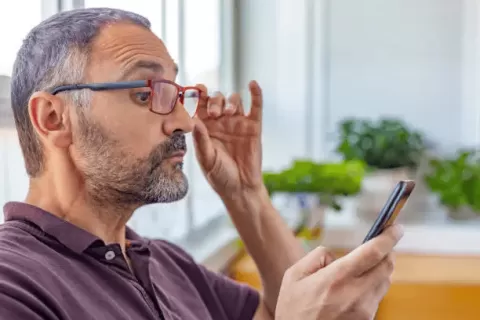
- Holding your phone or newspaper at arm's length to read.
- Needing brighter light for near tasks, especially at night.
- Headaches, tired eyes, or eye strain after long reading or screen work.
| Important: Presbyopia itself is not "dry eye disease." But many people notice dryness and burning around the same age because screen time rises and tear stability can change with age, so the two can overlap in real life. |
How Doctors Diagnose Presbyopia?
Diagnosis is straightforward and doesn't need fancy tests for most people. Your eye doctor checks distance and near vision, and then measures how much "add" power you need for comfortable reading.
If you also have distance power (myopia/hyperopia/astigmatism), your prescription will be updated to balance both distance and near needs.
Presbyopia Treatment Options
Presbyopia can't be reversed back to "young years focusing," but it can be managed very well.
| Option | What does it do? | Who does it suit? | Trade-offs |
| Reading glasses | Adds "plus" power for near | First-time presbyopia, occasional reading | You'll take them on/off |
| Progressives / bifocals | One pair for near + distance | People who switch between phone + driving | Takes adaptation time |
| Multifocal contacts | Near + distance in contacts | People who dislike glasses | Fit/comfort can be tricky |
| Monovision (contacts or laser) | One eye for distance, one for near | People okay with brain adaptation | Depth perception reduce |
| Presbyopia eye drops (pilocarpine 1.25%) | Improves near vision by making the pupil smaller | Mild-to-moderate presbyopia | Cause headache/redness; night driving caution |
| Lens-based surgery (RLE/IOL) | Replaces natural lens with an IOL | For older patients, esp. with early cataract | Halos/glare possible with some IOLs |
Reading Glasses
Reading glasses are the simplest solution because they only "switch on" when you need near vision. If your distance vision is fine, you can treat presbyopia like a practical problem: wear readers for messages, bills, and menus, then take them off.
Progressive / bifocal glasses
Progressive lenses are a "one pair for everything" option. They have different powers in different zones, so you can see far, intermediate (laptop), and near (phone) in the same glasses and you don't need separate reading glasses.
The first few days can feel strange because you must learn where the near zone sits. Some people notice a mild "swim" effect at the edges, especially with cheaper designs.
Multifocal contact lenses
Multifocal contacts try to give both near and distance vision at the same time. Your brain learns to pick the sharper image depending on what you're looking at.
It suits people who dislike glasses, do outdoor routines, and want glasses-free convenience most days. Some people notice halos at night or slightly less crisp contrast, especially in dim light. Dry-eye-prone people also struggle with comfort, so lens choice and dryness control matter.
Monovision contact lenses (trial first approach)
Monovision means one dominant eye is set for distance and the other for near. It sounds odd, but many people adapt surprisingly well once the brain learns to blend.
It is suitable for people who like the idea of less dependence on glasses and are comfortable with the ?balanced compromise? approach.
But depth perception can feel slightly reduced (for example, steps, parking, night driving). That's why contact lenses are a good trial, you can test it for a few days and see if your brain likes it.
Monovision LASIK / laser options
This needs a clean explanation because some information on internet makes LASIK sound like a presbyopia ?cure.? Presbyopia happens mainly because the lens inside the eye becomes less flexible with age, so standard LASIK does not stop the aging process.
LASIK can reshape the cornea to create a monovision effect, distance in one eye, near in the other, similar to monovision contacts, but more permanent. It is perfect for people who already did well with monovision contacts because that's the best predictor they'll tolerate it long-term.
But everyone should remember that it's not reversible like contacts. Some people don't like the compromise, especially if they do precision tasks, heavy night driving, or want "perfect sharp" at both far and near.
Eye drops for presbyopia
These drops are a newer option and they work differently from glasses or lasers. They don't change the eye's lens flexibility. Instead, they make the pupil smaller, which increases depth of focus, like narrowing a camera aperture so more looks in focus.
Pilocarpine 1.25% drops (FDA-labeled as once daily) can improve near vision by constricting the pupil, which increases depth of focus.
It's very good for mild-to-moderate presbyopia, and for people who want help mainly for evening reading or short near tasks, and those who don't want glasses all the time.
The effect is time-limited. Evidence summaries describe onset around 15 minutes, peak around 1 hour, and effect lasting roughly 6/10 hours depending on formulation and individual response.
But some people get headaches, eye redness, or a dimmer feel in low light. Night driving can be tricky for some users because a smaller pupil can change how lights look.
Lens replacement surgery (RLE / presbyopia IOLs)
Refractive lens exchange replaces the natural lens with an intraocular lens (IOL), similar to cataract surgery.
It can be a practical option when someone is older and already trending toward early cataract, but lens choices (multifocal/EDOF) can bring glare/halos in some patients.
Corneal inlays (not used now)
A corneal inlay is a very small implant, smaller than the width of an eraser tip, that is surgically placed in a person's non-dominant eye.
AAO notes two FDA-approved corneal inlays (KAMRA and Raindrop) were implanted in the U.S., but the Raindrop was recalled/discontinued due to corneal haze risk.
Although the KAMRA remains FDA-approved, it has not been manufactured or marketed since 2022.
So if a clinic mentions inlays, it's worth asking what device, what evidence, and current availability in your region.
Natural Ways to Manage Presbyopia
This is important for readers because "eye exercises" are heavily marketed everywhere on the internet as the cure for presbyopia but reality is very different:
- Eye exercises can reduce eye strain from long near work, but they don't restore lens flexibility, so they can't reverse presbyopia.
- Better lighting for reading, regular breaks, and correct prescriptions reduce headaches and fatigue more than any "routine."
- If you have diabetes or thyroid issues, keeping them controlled matters for overall eye health, but presbyopia itself is still an age-driven focusing change.
Conclusion
Age related vision loss presbyopia is one of the most common and most manageable vision changes that comes with aging, starting in the early-to-mid 40s and progressing until around the mid-60s.
The best approach is simple: confirm the diagnosis with an eye exam, choose the right correction, and adjust over time as your near needs change.
Presbyopia isn't dangerous by itself, but if your blur is sudden, one-sided, or paired with pain/flashes, that needs a different kind of check. Age related presbyopia becomes much easier to live with when you treat it like a normal life stage, not a mystery.
FAQs
Is presbyopia age related or caused by screens?
Yes, presbyopia is age related and not caused by screens. It mainly happens because the lens becomes less flexible with age. Screens can increase eye strain and make symptoms feel worse, but they don't cause the underlying lens stiffening.
What is presbyopia by age and when do most people need reading glasses?
Presbyopia by age is a natural condition where your eye loses the ability to focus on nearby objects, it becomes noticeable around 40/45, and it progresses until around 65. Some people need readers earlier depending on their baseline prescription and near work.
Can presbyopia be cured permanently?
No, presbyopia cannot be cured permanently. It can't be reversed back to youthful days, but it can be corrected very effectively with glasses, contact lenses, certain surgical strategies, or prescription drops that improve near focus for a few hours.
Does LASIK fix age related presbyopia?
No, LASIK cannot fix age related presbyopia because presbyopia comes from lens aging, not corneal shape alone. Some people use monovision LASIK to reduce reading-glasses dependence, but it's a trade-off and not ideal for everyone.
Are presbyopia eye drops safe and how long do they last?
Prescription drops like pilocarpine 1.25% are dosed once daily and work mainly by making the pupil smaller, improving depth of focus. Reports describe onset in about 15 minutes and effect lasting roughly 6/10 hours depending on the person and product, and they can cause side effects like headache or redness in some users.
Could not find what you are looking for?


