Are Cataracts Hereditary? Genetic, and Family History
- By Centre For Sight
- 9 minutes
Key Takeaways
|
Hereditary cataracts are real, but they are not the reason behind every cataract. Many people ask can cataracts run in families, especially when a parent, grandparent, or child has been diagnosed, and the answer depends a lot on the age at which the cataract appears and the pattern in the family.
In this blog, you will learn the difference between age-related cataracts and genetic cataracts, what family history of cataracts actually means, and when congenital cataracts causes need a closer medical look.
Are Cataracts Hereditary?
Yes, some cataracts are hereditary, but most cataracts in adults are still mainly age-related. Family history of cataracts is a factor that can speed cataract formation in adults, but cataracts mostly develop as lens proteins break down with aging, and by age 75 most people have cataracts that affect vision.
That is why the family story matters so much. If your grandmother had cataract surgery in her 70s, that does not automatically mean you have a strong inherited cataract condition.
But if several relatives developed cataracts unusually early, or if a baby in the family was born with lens clouding, then a hereditary cause becomes much more important.
What Are Cataracts, and Why Do They Happen?
A cataract is a clouding of the eye’s natural lens. In most adults, it happens slowly with age as lens proteins begin to break down and the lens becomes cloudy, which is why vision turns blurry, dull, or glare-prone over time.
Doctors divide cataracts into broad groups:
- Age-related
- Congenital
- Hereditary
- Traumatic
- Metabolic
- Inflammatory
- Medicine-related.
This matters because the answer to “is it genetic?” is much more likely to be yes in a child with cataracts from birth than in an older adult with a slowly developing cataract after age 60.
Hereditary Cataracts Vs Age-Related Cataracts
The easiest way to understand this topic is to compare the common pattern with the inherited one.
| Type | When it appears? | Main driver | Family link |
| Age-related cataract | Later adult life, after 60 | Aging of the lens | Family history increases risk, but aging is still the main reason |
| Congenital cataract | Present at birth | Genetic change, infection, metabolic disorder, or syndrome | Family history can be very important |
| Hereditary childhood cataract | Infancy or early childhood | Inherited gene change | Strong family link |
| Secondary cataract | Any age | Steroids, diabetes, inflammation, radiation, trauma | Not mainly inherited |
What Are Genetic Cataracts?
Genetic cataracts are cataracts linked to inherited gene changes. They are most important in babies, children, and younger adults with early cataracts, especially when the cataracts affect both eyes or when other family members had the same problem early in life.
A 2020 review on congenital cataract reported that in most cases of bilateral congenital cataract, a causative genetic mutation can be identified, and autosomal dominant inheritance was the most common pattern at 44%. (National Library of Medicine)
Most inherited childhood cataracts are autosomal dominant, while recessive and X-linked forms are less common.
For a normal reader, “autosomal dominant” simply means this: if one parent carries the faulty gene, the condition can pass to the child even when only one copy is inherited. That is why doctors pay close attention to a clear pattern of cataracts moving across generations.
Can Cataracts Run in Families Even in Adults?
Yes, they can. Family history of cataracts is a risk factor for adult cataract, and reviews of age-related cataract genetics show that heredity still plays a role even when cataracts appear later in life.
One review noted that having a sibling with cataracts increased the risk of age-related cataract about threefold and estimated that about 8.3% to 25% of congenital or infantile cataracts are inherited. (National Library of Medicine)
Still, this does not mean every adult cataract is “inherited.” A more accurate way to say it is that family history can increase your risk, but the final cataract picture is shaped by both genes and life factors such as diabetes, smoking, steroid use, eye injury, inflammation, radiation, and sun exposure.
Congenital Cataracts Causes: Why Babies Can Be Born With Cataracts?
This is the part where genetics becomes much more important.
Congenital cataracts are present at birth and are rare, and a recent review estimated global prevalence at roughly 0.63 to 9.74 per 10,000 people, with a median of 1.71 per 10,000. (National Library of Medicine)
Common congenital cataracts causes include:
- Inherited or familial cataracts, where the lens clouding runs in the family and can affect one or both eyes.
- Infections during pregnancy, especially congenital rubella.
- Metabolic disorders, such as galactosemia, where the body cannot process certain sugars properly.
- Chromosomal and syndromic conditions, such as Down syndrome, Lowe syndrome, trisomy 13, and some skeletal or developmental syndromes.
- Unknown causes, because in many people, no clear cause is found.
This is why childhood cataracts are treated very differently from routine adult cataracts.
In a baby, the doctor is not only asking, “How cloudy is the lens?” but also, “Why did this happen, and is there an inherited or systemic disorder behind it?”
When Should You Suspect a Strong Family Link?
A strong inherited link becomes more likely when cataracts appear unusually early, affect both eyes, or show up in several relatives across generations. That pattern is more suggestive of hereditary cataracts than of ordinary aging.
A few clues matter more than others:
- Cataracts in infancy, childhood, or young adulthood are much more suspicious for a genetic cause than cataracts starting in older age.
- Bilateral cataracts, especially in children, push doctors to think more seriously about genetics and systemic causes.
- Several affected relatives, especially parent-child patterns, make autosomal dominant inheritance more likely.
- Associated medical or developmental conditions point towards a syndrome rather than an isolated eye problem.
Symptoms: Do Hereditary Cataracts Look Different?
In adults, hereditary and non-hereditary cataracts cause the same kind of symptoms: blurry vision, glare, faded colours, poor night vision, halos, and frequent changes in glasses. The difference is not in the symptom itself, but in when it starts and who else in the family has had it.
In babies and children, the warning signs are different. Congenital cataracts show up as a gray or white pupil, a missing or abnormal red reflex in photographs, unusual rapid eye movements, or poor visual awareness of the world.
That is why examples help here. In an older adult, cataract feels like slowly worsening blur. In a baby, it first looks like a white shine in one pupil in flash photos or a child who does not seem to fix and follow eye movement normally.
How Doctors Check Whether Cataracts Are Hereditary?
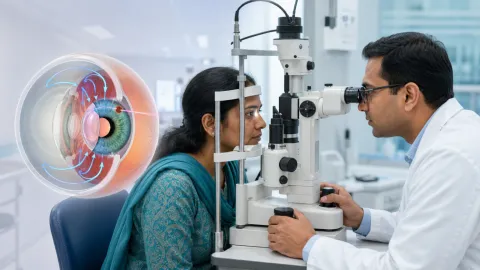
The first step is still a proper eye examination. Adult cataracts are diagnosed with a standard eye exam and slit-lamp examination, while congenital cataracts need a complete eye exam by an ophthalmologist.
Doctors combine a few things:
| What the doctor checks? | Why does it matter? |
| Age of onset | Early cataracts raise more suspicion for genetics |
| One eye or both eyes | Bilateral cataracts matter more in inherited cases |
| Family history | Helps show whether cataracts run through the family |
| Full eye exam and slit lamp | Shows the type, density, and location of the cataract |
| Red reflex in babies | Helps detect congenital cataracts early |
| Pediatric or systemic evaluation | Looks for infections, metabolic disease, or syndromes |
| Genetic counselling/testing | Advised in inherited or unexplained childhood cases |
Does Family History Change Treatment?
The basic cataract treatment is still the same in one important way: if the cataract is affecting vision enough, the only definitive treatment is surgery.
What changes is the rest of the plan. In adults with a strong family history of cataracts, the doctor simply recommends earlier and more regular checks.
In babies and children, the response is more urgent, because untreated cataracts can interfere with visual development and need not only surgery but also patching, visual rehabilitation, and investigation of the underlying cause.
What You Can Actually Do If Cataracts Run in Your Family?
This is where many readers want a simple answer. You cannot stop every cataract just because you know it runs in your family, but you can lower avoidable risk and catch problems earlier.
A sensible plan looks like this:
- Know your family history clearly, not vaguely. Try to find out who had cataracts, at what age, and whether surgery happened unusually early.
- Get checked sooner if cataracts appeared early in your family, especially if people developed them before the usual older-age pattern.
- Protect your eyes from UV exposure with proper sunglasses outdoors, because excess sunlight is one avoidable cataract risk.
- Control diabetes and avoid smoking, because both are well-established cataract risk factors that can add to any inherited risk.
- Ask about genetic counselling if a baby is born with cataracts or if multiple close relatives had early cataracts.
Conclusion
Hereditary cataracts do exist, and can cataracts run in families is a fair question, but the answer is not the same for every age group.
In older adults, cataracts are still mainly age-related, though a family history of cataracts can increase risk.
In babies, children, and younger adults with early or bilateral cataracts, genetic cataracts and other congenital cataract causes become much more important and need deeper medical and genetic evaluation.
The safest next step is simple: if cataracts seem to appear unusually early in your family, do not wait for vision to become very poor before getting checked.
Frequently Asked Questions
Can cataracts really run in families?
Are all cataracts hereditary?
What is the difference between hereditary cataracts and genetic cataracts?
What are the main congenital cataracts causes?
If I have a family history of cataracts, do I need surgery earlier?
Could not find what you are looking for?


