Senile Cataracts: Causes, Symptoms, and Treatment Options
- By Centre For Sight
- 6 minutes
The gift of sight is often something we take for granted until the world begins to look blurry. For many older adults, a gradual blurring of vision isn't just a sign of "getting old"; it is the clinical onset of senile cataracts. As the leading cause of reversible blindness globally, understanding this condition is vital for maintaining quality of life well into your golden years. At Centre For Sight, we believe that informed patients make the best decisions for their ocular health. This blog explains the senile cataract meaning, its progression from an immature senile cataract to a mature senile cataract, and the revolutionary treatment options available today.
What Are Senile Cataracts?
To understand senile cataracts, one must first understand the anatomy of the eye. Behind the iris (the colored part of your eye), there is a natural crystalline lens. As we age, the biochemical composition of the lens changes. The lens is primarily composed of water and protein fibres. Over decades, these proteins begin to denature and clump together. This clumping creates opacities that scatter light rather than allowing it to pass through cleanly.
The Progression: From Immature to Mature
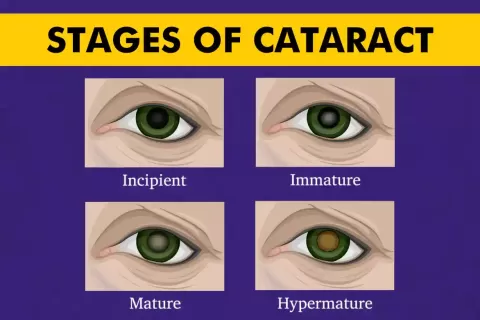
- Immature Senile Cataract: At this stage, the lens still has some clear areas. While the patient may experience "cloudiness" or a need for stronger reading lights, the eye doctor can still view the retina clearly during an examination.
- Mature Senile Cataract: This is when the lens becomes totally opaque, often appearing white or brownish-yellow. At this stage, functional vision is significantly lost, and the patient may only be able to distinguish light from dark.
Causes of Senile Cataracts
While ageing is inevitable, the speed at which a cataract develops can be influenced by various external and internal factors, such as:
- Oxidative Stress: Over time, the eye is exposed to free radicals. Without enough antioxidants to neutralise them, these radicals damage the lens proteins.
- UV Exposure: Chronic, unprotected exposure to ultraviolet (UV) B rays from the sun can accelerate protein damage in the lens.
- Medical Conditions: Systemic diseases, particularly Diabetes Mellitus, can cause cataracts to develop much earlier due to high sugar levels in the aqueous humor affecting lens metabolism.
- Lifestyle Choices: Smoking and heavy alcohol consumption introduce toxins into the bloodstream that have been scientifically linked to increased cataract density.
- Medications: Long-term use of corticosteroids (often used for asthma or arthritis) is a well-known cause of posterior subcapsular cataracts.
- Previous Eye Surgery or Injury: High myopia (near-sightedness) or previous retinal surgeries can predispose the lens to clouding.
Types of Senile Cataracts
Depending on where the clouding begins, there are different types of senile cataracts, and each of them possesses different symptoms.
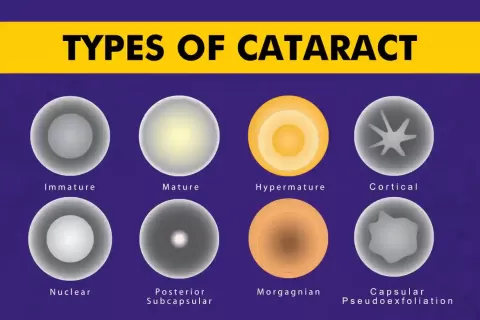
- Nuclear Sclerosis Cataract
This is the most common form of age-related cataract. It forms in the nucleus (the centre) of the lens. It often causes the lens to harden and turn yellow or brown. Interestingly, nuclear cataracts can temporarily improve near vision (reading) as the lens becomes more convex, though this is temporary and followed by significant blurring.
- Cortical Cataract
This type starts in the periphery of the lens (the cortex) and works its way toward the centre in a spoke-like fashion. Patients often complain of intense glare, especially from oncoming headlights while driving at night.
- Posterior Subcapsular Cataract
This forms at the very back of the lens, right in the path of light as it travels toward the retina. This type progresses faster than others. It significantly impacts vision in bright sunlight and makes reading particularly difficult.
Possible Complications If Untreated
- Phacomorphic Glaucoma: The cataractous lens becomes so large that it blocks the fluid drainage in the eye, leading to a painful spike in eye pressure.
- Lens-Induced Uveitis: The leaking of lens proteins can cause severe internal inflammation.
- Increased Fall Risk: Loss of depth perception and contrast sensitivity in older adults is a leading cause of hip fractures and falls.
- Social Isolation: When you can no longer see the faces of your grandchildren or enjoy your favourite hobbies, it can lead to depression and withdrawal.
Diagnosis of Senile Cataracts
At Centre For Sight, a diagnosis is reached through a series of non-invasive tests during a comprehensive eye exam:
| Test Name | What it Measures |
| Visual Acuity Test | Your ability to read letters of varying sizes on a chart. |
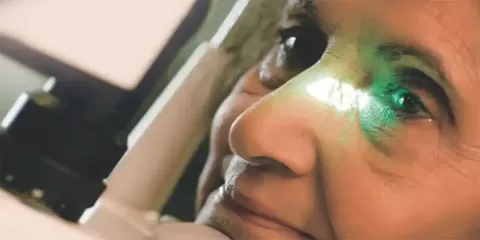
| Slit-Lamp Examination | A microscope that allows the doctor to see the lens in 3D layers. |
| Tonometry | Measures the pressure inside your eye to rule out glaucoma. |
| Dilated Eye Exam | Eye drops are used to widen the pupil, allowing a full view of the retina and optic nerve. |
Senile Cataracts Treatment Options
The only way to treat a cataract is through surgical intervention. However, modern surgery is one of the most successful and refined procedures in all of medicine.
- FLACS (Femto Laser Cataract Surgery)
Your eye is scanned with advanced cameras and OCT to generate detailed 3D maps, allowing the surgeon to plan each laser step precisely. After numbing your eye with drops, the femtosecond laser creates incisions and softens the cataract. The fragmented cataract is gently sucked out with ultrasound energy.
- MICS
Micro incision cataract surgery is a cataract removal technique through a tiny cut (about 1.8?2.2 mm) with a foldable IOL placed through the same opening.
- Phacoemulsification
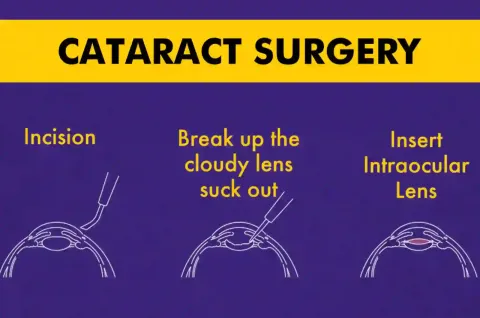
This is the gold standard. A tiny incision (often less than 3mm) is made. An ultrasonic probe "breaks up" the cloudy lens into microscopic pieces, which are then suctioned out.
The Role of the Intraocular Lens (IOL)
Once the natural lens is removed, the eye can no longer focus light. An artificial intraocular lens (IOL) is inserted into the empty lens capsule. Your choice of IOL will determine your visual quality after surgery:
- Monofocal IOLs: These are the most common. They provide excellent vision at one distance (usually far). You will likely still need reading glasses for close-up work.
- Multifocal IOLs: These advanced lenses have different zones for near, intermediate, and far vision, significantly reducing or even eliminating the need for glasses altogether.
- Toric IOLs: Specifically designed for patients who also have astigmatism.
Recovery After Senile Cataracts
The recovery phase is often much easier than patients anticipate. Most procedures take about 15?20 minutes and are performed on an outpatient basis. Immediate Timeline: You may wear a protective shield for the first day. Vision is often blurry for 24 hours but clears rapidly. Activities: You can watch TV and read within a day. However, you should avoid heavy lifting, bending over, or swimming for at least two weeks. Follow-up Visits: Usually scheduled for 1 day, 1 week, and 1 month after surgery to ensure the IOL is stable and there is no infection.
Can Senile Cataracts Be Prevented?
While you cannot stop the clock on ageing, you can mitigate the speed of lens degradation:
- Wear Polarised Sunglasses: Look for 100% UV Protection labels.
- Healthy Diet: Eat diets high in Vitamin C, Vitamin E, and Lutein-enriched food.
- Control Blood Sugar: If you are diabetic, keeping your HbA1c in check is the best thing you can do for your eyes.
- Quit Smoking: Smoking increases the amount of free radicals in your eyes.
Conclusion
From the early stages of an immature senile cataract to the advanced stages of a mature senile cataract, the progression is a signal from your body that your eyes need professional care. With timely diagnosis and treatment, you can regain clear vision.
Could not find what you are looking for?


