Keratoconus Eye Disorder: Types, Signs, and Treatments
- By Centre For Sight
- 7 minutes
Blog Summary
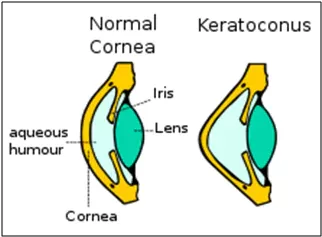
- Keratoconus causes thinning and bulging of the cornea, transforming it from a dome to a cone shape, which disrupts normal vision.?
- It often starts in adolescence and may be associated with allergies (like asthma or eczema) and frequent eye rubbing.?
- Symptoms include rapidly changing prescriptions, ghosting or multiple images, light sensitivity, glare, and a foreign?body sensation.
- Diagnosis involves refraction, slit-lamp exam, corneal topography (e.g., Pentacam), and corneal thickness measurement (pachymetry).?
- Corneal collagen cross-linking (C3R/CXL) is used to strengthen the cornea and slow or stop the disease progression.?
- Vision correction can be achieved through spectacles, rigid gas-permeable lenses, specialized keratoconus lenses, or intracorneal ring segments (INTACS).?
- In advanced cases, options include toric implantable collamer lenses (ICL) or corneal transplant (partial or full) for restoring vision.
Keratoconus is an eye disorder which causes thinning of the cornea. It also causes a change in the shape of the cornea.?Many patients of Keratoconus find problems in carrying out some basic activities of day to day life like reading, watching, driving, cooking, etc. In this blog, we will learn what Keratoconus is, causes,? symptoms, diagnosis, and treatment for Keratoconus.
What is Keratoconus?
Keratoconus is an eye condition where the clear front surface of the eye (the cornea) slowly becomes thinner and starts to bulge outward into a cone-like shape.?Because the cornea is no longer smooth, light does not focus properly inside the eye, so vision can look blurred, stretched, or oddly ?shadowed.??For example, streetlights at night look like they have halos or streaks, letters on a phone screen seem doubled or smeared, and one eye suddenly needs frequent power changes even after a new pair of glasses.?
In simple terms, it's like the eye's ?front window? changes from a smooth dome to an uneven, pointed surface, so the picture your eye sends becomes less clear.
Recognizing Keratoconus Symptoms and Signs
Early keratoconus signs include:
- Blurred or distorted vision
- Increased sensitivity to light and glare
- Frequent changes in eyeglass prescriptions
- Sudden worsening or clouding of vision
As the disease progresses, these keratoconus symptoms become more severe, making vision correction increasingly challenging.
Causes of Keratoconus
While the exact keratoconus causes are not fully understood, several factors contribute to its development:
- Genetic predisposition: Family history may increase the risk.
- Environmental factors: Excessive eye rubbing, often due to allergies, can exacerbate the condition.
- Biochemical factors: An imbalance of enzymes in the corneal tissue may lead to weakening and thinning of the cornea.
Types of Keratoconus
The types of Keratoconus are determined by the cornea's shape and the area where the cornea has thinned. In addition to uncommon variations, the disease comes in four main types.
Nipple cone keratoconus or round keratoconus
Although just a tiny portion of the cornea is affected by round or nipple cone keratoconus, the slope of the afflicted area can be extremely steep. This kind of Keratoconus causes a noticeable decline in vision.
Sagging cone keratoconus or oval keratoconus:
A wider area of the cornea is impacted by oval or sagging cone keratoconus. The internal membranes of the cornea may tear (or hydrops), leading to scarring and making contact lens fitting more challenging.
Forme fruste keratoconus
The most popular form of Keratoconus is called fruste. In actuality, former fruste Keratoconus is typically symptomless and can only be identified through mapping the eye's surface. Forme fruste keratoconus is a condition that first manifests but does not proceed for whatever reason. Treatment is not usually necessary for those who have formed fruste Keratoconus.
Keratoglobus keratoconus
A unique form of Keratoconus causes the entire cornea to thin and extend forward. The optimum vision correction typically includes using conjunctival lenses with a big diameter.
Different Keratoconus Stages
Here we discuss the stages of Keratoconus-
1. Initial Keratoconus:
Only very tiny corneal deformation, little to no impact on vision quality, and little to no progression are all characteristics of early-stage Keratoconus. Spectacles typically provide adequate eyesight while successfully treating myopia and astigmatism.
2. Moderate Keratoconus:
In this stage, it is possible to see corneal changes typical of Keratoconus and increased corneal distortion. Rigid gas permeable contact lenses are an alternative for enhanced vision as the quality of vision with glasses declines.
3. Advanced Keratoconus:
At this stage, there is significant corneal deformation, mild keratoconus alterations, and light to severe corneal scarring. The rigid gas permeable contact lens design may be subject to more modifications than for moderate Keratoconus, frequently utilizing much higher interior curvatures to maintain an effective fitting.
4. Severe Keratoconus:
Dramatic corneal deformation, significant corneal scarring, and thinning are all symptoms of severe Keratoconus. With stiff gas permeable contact lenses, eyesight is frequently poor, contact lens tolerance is significantly reduced, and it's typically quite challenging to properly fit a rigid gas permeable contact lens. If we talk about severe?keratoconus treatment, it is advised to contemplate a corneal transplant after being referred to a skilled corneal surgeon.
How to identify keratoconus?
Your?eye doctor will examine your eyes?and inquire about your medical background. They will assess your vision's clarity. You might need to dilate your eyes for a portion of the exam. Your healthcare professional will prescribe eye drops to you to enlarge (dilate) the black area in the center of your eye. This enables your provider to get a clearer view of more of your eye. The shape of your cornea may also be measured by a tool by your healthcare professional. Your doctor might use a corneal topography imaging test to aid in the diagnosis. Changes in the cornea's shape are visible with this examination.
Diagnosis for Keratoconus
A complete assessment for keratoconus includes:
- Refraction and visual acuity evaluation
- Intraocular pressure measurement
- Slit lamp examination and retina evaluation
-
- Corneal topography: Advanced topography systems such as the Pentacam and Orbscan assess the overall architecture of the cornea and help in early detection of keratoconus. These tests are also important in assessing the progression of keratoconus and in deciding the appropriate treatment options.
- Corneal Thickness measurement (Pachymetry)
Treatment for keratoconus
The course of your keratoconus treatment may change depending on how severe your Keratoconus is. Your specific kind of Keratoconus may also affect your keratoconus treatment options.
Early on, you might require glasses to correct the keratoconus-related vision impairment. If glasses don't work, another alternative is to use specialized contact lenses. These connections are frequently gas-permeable. These need to be fitted carefully to your cornea.
Many patients won't require any additional care. However, you could need a different treatment if your cornea becomes too damaged or unable to support a contact lens. A?corneal transplant is the standard course of action in this case. Part or all of the native corneal thickness is removed with this procedure. It is changed with a deceased donor's cornea (cadaver donor).
There are a variety of Keratoconus treatments, such as:
- Collagen Crosslinking in the Cornea (CXL)
- contact lens (Custom Soft, Gas Permeable, Rose K, Corneal, Scleral, and Mini-scleral)
- Implants by Intacs
- Implantation of Personalized Stromal Lenticules
- Photorefractive keratectomy (PRK) with topography guidance and CXL
- Deep anterior lamellar keratoplasty for corneal transplantation (DALK).
Why Choose CFS?
As one of?India's most well-known eye hospitals, Centre for Sight, takes pleasure in providing the best Keratoconus treatment. We are dedicated to providing our patients with fresh perspectives and cost-effective solutions.?C3R or CXL, also known as corneal collagen crosslinking with riboflavin, is a promising treatment for Keratoconus.
Centre for Sight is well-equipped with cutting-edge technology and ultra-modern technology for the early evaluation and treatment of Keratoconus.
Conclusion
Understanding types of keratoconus, recognizing keratoconus symptoms, and consulting an eye care professional early can prevent severe vision loss. Regular eye examinations are crucial, especially for individuals with a family history or frequent eye rubbing. Proper keratoconus treatment and timely keratoconus surgery can help maintain quality vision and slow disease progression.
Frequently Asked Questions
What are the symptoms and signs of keratoconus?
What causes keratoconus?
What are the treatment options for keratoconus?
What are the four stages of keratoconus?
What are two common signs of keratoconus?
What is the best age to treat keratoconus?


Could not find what you are looking for?


