10 Things You Must Take in Your Diet to Keep Your Eyes Healthy
- By Centre For Sight
- 9 minutes
|
Key Takeaways:
|
To keep your vision steady over the years, what you eat matters more than most people realise, especially for the retina and the eye surface. The conflict is that ?eye foods? advice online is half-true, so people over-trust carrots and ignore the nutrients that actually show up in research.?
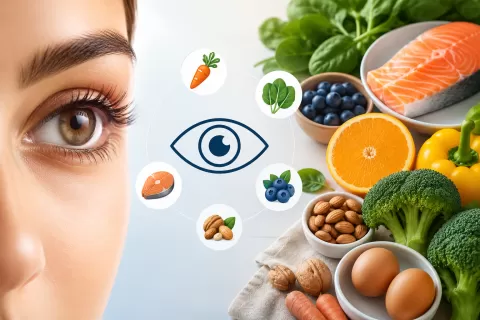
In this blog, you'll learn about the 10 healthy foods for eye health that help most, the nutrients behind it, and a practical diet for healthy eyes you can follow without overthinking.
Why Food Matters For Your Eyes?
Your eyes are high-energy organs. The retina (especially the macula) is exposed to light and oxygen all day, so it benefits from nutrients that support normal cell function and help manage oxidative stress.?
Research also shows that lutein and zeaxanthin are the only dietary carotenoids that concentrate in the macula (they form ?macular pigment?), which is why leafy greens and certain colourful foods get so much attention.?
The Nutrients That Are Good For Eye Health
Before we go into the food list, it helps to know what each nutrient does in simple terms.
|
Nutrient |
Best food sources |
Why does it help your eyes? |
|
Lutein + zeaxanthin |
Spinach, kale, collards, eggs |
Build macular pigment (retina support) |
|
Vitamin A / beta-carotene |
Carrots, sweet potato, leafy greens |
Needed for the retina's low-light vision system; deficiency can cause night blindness? |
|
Vitamin C |
Citrus, berries, bell peppers |
Antioxidant support |
|
Vitamin E |
Almonds, sunflower seeds, peanuts |
Antioxidant support |
|
Zinc + copper |
Beans, nuts, seafood, whole grains |
Zinc is part of the AREDS formula; copper is added with high-dose zinc |
|
Omega-3 (DHA/EPA) |
Fatty fish (salmon/sardine), some seeds |
DHA is a major structural fat in the retina |
Note: The AREDS formulation (Age-Related Eye Disease Study) is a specific nutritional supplement designed to slow the progression of moderate-to-advanced age-related macular degeneration (AMD).
Best Foods For Eye Health
If you want food for improving eyesight, think in two buckets:?
(1) foods that support the retina (macula health) and?
(2) foods that support comfort (tear film and inflammation balance).?
Here's a modern list that keeps the bests, fixes the misunderstanding, and adds what's missing.
1) Green leafy vegetables (spinach, kale, collards)
Leafy greens are one of the most practical foods for the eyes because they're rich in lutein and zeaxanthin. The AAO highlights leafy greens like kale and spinach as ideal sources of these macular pigments.?
An easy way to eat them daily is to add a handful of spinach to dal, omelette, poha, or a sandwich. Small habits beat perfect meal plans.
2) Eggs (especially the yolk)
Eggs are a convenient way to get lutein and zeaxanthin in a form the body can absorb well because they come with fat. They also support overall nutrient intake in a balanced diet. If you don't eat greens daily, eggs are a realistic ?backup? source.
3) Orange vegetables (carrots, sweet potato, pumpkin)
Carrots are helpful because beta-carotene can be converted to vitamin A, which is essential for the retina's low-light function.?But it's important to keep expectations real as carrots don't ?repair? eyesight or remove glasses if your blur is due to refractive error.?
Vitamin A is vital, and deficiency can cause night blindness, but extra intake beyond needs won't magically sharpen vision. Best use is to include one orange vegetable most days for steady vitamin A support.
4) Fatty fish (salmon, sardine, mackerel)
Omega-3 fats (especially DHA) are part of normal retinal structure. You'll see claims like ?fish prevents glaucoma,? but strong prevention claims are not the standard message in major clinical sources.?
What's fair to say is that omega-3 supports general health and helps dry eye in some people, but dry eye supplement studies have mixed findings (some show little benefit).?
If you don't eat fish, talk to your clinician before starting supplements, especially if you're on blood thinners.
5) Nuts and seeds (almonds, walnuts, sunflower seeds)
Nuts and seeds are an easy ?snack upgrade? because they add vitamin E and other supportive nutrients. Vitamin E is part of the classic AREDS antioxidant set used in specific AMD patients. A small handful is enough, more isn't always better because calories add up.
6) Citrus fruits (oranges, mosambi, amla, lemon)
Citrus is a clean way to add vitamin C, a key antioxidant. Vitamin C appears in AREDS research formulas used for particular stages of age-related macular degeneration (AMD). A simple habit is to add one vitamin-C fruit daily rather than chasing ?superfoods.?
7) Berries (blueberries, strawberries, jamun)
Berries add vitamin C and polyphenols, which is why they're included in ?eye diet? lists. They're not a cure, but they fit the broader pattern of a colourful, antioxidant-rich plate.
If berries are expensive, eat guava and amla as they are also strong vitamin-C alternatives.
8) Beans and dals (rajma, chana, masoor, moong)
Legumes are underrated healthy food for eye health because they contribute zinc and plant antioxidants while supporting steady energy (less sugar spike ? better for long-term metabolic health).?
Zinc is part of the AREDS formula, and copper is paired with high-dose zinc in that research. Try adding sprouts or a dal bowl 4?5 days a week.
9) Tomatoes and red bell peppers
Tomatoes contribute vitamin C and carotenoids. Older studies claim carotenoid ?prevents light damage,? but the stronger, more consistent nutrition story for eyes is still lutein/zeaxanthin, vitamins C/E, zinc, and omega-3s.?
Tomatoes are still a good supporting food in a colourful diet and try to pair tomatoes with a little fat (olive oil, peanuts) for better carotenoid absorption.
10) Whole grains (oats, brown rice, millets)
Whole grains support overall metabolic health and can contribute minerals like zinc and B vitamins as part of a balanced pattern. Think of them as the ?base? that helps you stick to your diet for healthy eyes consistently.?
Small Daily Habits That Make The Diet Work
These aren't ?foods,? but they decide whether your plan actually sticks.
- Aim for colour, not perfection:?
One leafy green + one orange/red vegetable + one fruit daily is an easy default that covers many nutrients the eye uses.?
- Add healthy fats to absorb carotenoids:?
Lutein/zeaxanthin are better absorbed when meals include some fat like eggs, nuts, or oil.?
- If you're screen-heavy:
Dry eye symptoms are common in modern life, and diet can support comfort, but sleep, blinking breaks, and hydration still matter more than any single ?eye food.?
The Supplement Question People Ask
Once someone starts looking up the best foods for eye health, the next step is almost always the same. They search ?eye vitamins? and buy supplements hoping they'll sharpen vision.?
The truth is, most people do not need high-dose eye supplements if they don't have a diagnosed retinal condition. But there is one important exception, AREDS2, which was designed for people with certain stages of age-related macular degeneration (AMD), not for the general public.
What is AREDS2?
AREDS and AREDS2 are large studies run by the U.S. National Eye Institute (NEI). They tested whether a specific combination of vitamins and minerals can slow the progression of AMD in people who already have intermediate AMDor advanced AMD in one eye.?
That's why this comes up in a food blog, because the ?foods vs supplements? confusion is highest in AMD-related searches, and readers deserve a clear boundary between everyday nutrition and medical supplementation.
What's inside an AREDS2-style formula?
In follow-on guidance from the NEI/AREDS2 discussions, the common AREDS2-style mix includes:
- Vitamin C: 500 mg
- Vitamin E: 400 IU
- Zinc: 80 mg
- Copper: 2 mg
- Lutein: 10 mg
- Zeaxanthin: 2 mg
These are much higher than what most people get from food in a day, which is why this is treated like a clinical tool, not a casual ?vision booster.?
In plain terms, supplementation seemed to help most when the diet was already low in these nutrients, another reason food-first still matters even when supplements are considered.
If you haven't been told you have AMD (or you don't know what stage you're in), focus on a balanced diet for healthy eyes first and get an eye check-up before starting high-dose ?eye vitamins.?
|
Note: If someone smokes or used to smoke, supplement choice needs extra care because beta-carotene is avoided in AREDS2-related discussions due to increased lung cancer risk seen in smokers in other major studies.? That's why it's smart to choose high-dose eye supplements only with an eye doctor's guidance, after a retina exam confirms whether you're actually in the group that benefits. |
Conclusion
A smart diet for healthy eyes is a consistent mix of leafy greens, colourful vegetables, fruits, protein, and healthy fats.?The most evidence-backed nutrients for long-term eye support include lutein/zeaxanthin, vitamins C and E, zinc (with copper when zinc is high), vitamin A, and omega-3s, especially when they come from whole foods.?
Food won't replace glasses or ?fix? refractive error, but the best foods for eye health can support your retina, comfort, and overall eye health as you age.
FAQs
What are the best foods for eye health?
The best foods for eye health are leafy greens (lutein/zeaxanthin), eggs, orange vegetables (vitamin A support), citrus fruits (vitamin C), nuts/seeds (vitamin E), legumes (zinc), and fatty fish (omega-3).
Does food for improving eyesight remove glasses?
No, food for improving eyesight does not remove glasses. Glasses are needed because of refractive error (shape/length of the eye), and food can't change that.?
A good diet supports eye function and long-term tissue health, and it helps most when it prevents deficiency and supports retinal nutrition.?
Are carrots enough for healthy eyes?
No, carrots are not enough for healthy eyes. Carrots help because beta-carotene supports vitamin A, which is important for low-light vision, especially in deficiency states.
They're useful, but they're only one part of a wider diet that also needs lutein/zeaxanthin, vitamin C/E, zinc, and healthy fats.?
Do omega-3 supplements help dry eyes?
Some studies show little to no symptom benefit compared with placebo, while other reviews suggest possible improvements in certain cases, so results are mixed.?
If you're considering supplements, it's best to discuss with an eye doctor, especially if you take blood thinners.?
Should everyone take AREDS2 vitamins for eye health?
No, everyone should not take AREDS2 vitamins for eye health because AREDS2-style supplements are meant for specific AMD risk groups, not for everyone. Please consult an eye doctor before taking any supplements.?



Could not find what you are looking for?


