Keratoconus Double Vision: Early Signs and Treatment Options
- By Centre For Sight
- 5 minutes
Blog Summary
- Keratoconus is an eye condition in which the cornea becomes thinner and more conical.
- It can cause double vision or ‘diplopia’ as a result of improper focusing of light.
- Monocular double vision is common but is often neglected.
- Early symptoms include blurred vision, frequent power changes, light sensitivity, and headaches.
- The condition is increasingly common in Indian teenagers and young adults.
- Major risk factors are genetics, excessive eye rubbing, UV exposure, pollution, and allergies.
- Eye rubbing (common in India) is a key trigger that can worsen the condition.
- Keratoconus can affect daily activities, such as reading, driving, screen use, and balance.
- Early diagnosis is critical to prevent progression and permanent vision damage.
- Treatments range from RGP/scleral lenses to advanced options like corneal cross-linking (CXL) and surgery.
- CXL is the only treatment that can stop the progression of Keratoconus.
- In advanced cases, procedures like Intacs or corneal transplant may be required.
- Keratoconus-related double vision does not resolve on its own but is manageable with timely treatment.
Your eyes need a perfectly curved cornea to give you single vision. However, there are a few conditions that may interfere with your eyes. One of those conditions is Keratoconus, which may distort your vision and even cause double vision. This makes your day-to-day activities very difficult. In this blog, you will get to know what is Keratoconus, how it causes double vision, symptoms, causes, and what the Keratoconus treatment options are in India.
What is Keratoconus?
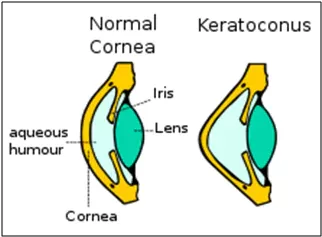
Keratoconus is a progressive eye disorder in which the cornea, the clear dome-shaped surface of your eye, starts to thin and become cone-shaped. This distorts your vision and even causes blurred vision.
Keratoconus often develops during adolescence or early adulthood. Its exact cause is not fully understood, but genetic predisposition and environmental factors such as eye rubbing and allergies are thought to contribute to its development and progression.
How Keratoconus Causes Double Vision?
One of the troubling effects of the condition is Keratoconus double vision, also known as diplopia.
In a healthy eye, the cornea ensures that incoming light rays focus at a single point on the retina. However, in keratoconus:
- Cornea becomes irregular and uneven
- Light rays scatter instead of focusing properly
- Multiple images or “ghosting” effects are formed
This results in double vision, where a person sees:
- Side-by-side images
- One image on top of another
- Shadowy or overlapping visuals
What are the Types of Double Vision in Keratoconus?
- Monocular Double Vision: Occurs in one eye even when the other is closed. This is common in keratoconus due to corneal distortion and is usually reported in the early stages, yet is often dismissed as “weak eyesight” or a refractive error.
- Binocular Double Vision: Binocular double vision occurs only when both eyes are open and is generally caused by misalignment of the eyes. Keratoconus more commonly causes monocular diplopia or ghosting due to irregular corneal optics.
Keratoconus Symptoms that you Shouldn’t Ignore
Symptoms of Keratoconus are often progressive, which is why many people have been visiting their opticians for a series of updated prescriptions over a period of time, never realising they have a problem. The common symptoms are:
- Blurry or distorted vision: May not be fully corrected with regular glasses, particularly as keratoconus progresses.
- Double vision: Seeing two images of a single object, even when you close one eye
- Progressive myopia: Increasing nearsightedness year after year
- Irregular astigmatism: Warped vision that cannot be corrected with regular glasses
- Sensitivity to light: Especially at night or in bright outdoor light
- Ghosting: Halos or faint shadowy images behind all objects
- Headaches: Happen due to constant squinting at objects
- Eye pain or a foreign body sensation: A gritty, irritated feeling in your eyes, as if something is present, even when nothing is there.
What are the Causes of Keratoconus?
Though the actual cause is yet to be discovered, the following factors contribute to the occurrence of keratoconus:
- Genetic Factors
The occurrence of Keratoconus is hereditary. If a family member has the disorder, regular eye tests starting at age 10 are advised.
- Eyes Rubbing
This is common among the people of India. People with allergies or who are exposed to dust tend to rub their eyes, which can damage the cornea.
- UV Rays
Increased sun exposure without proper eye protection damages the cornea.
- Environment
Polluted areas, allergies, dry climates, etc., in cities like Delhi, Mumbai, and Jaipur contribute to the occurrence of Keratoconus.
- Associated Factors
Other factors, such as allergic eye diseases, asthma, and Down syndrome, are also common risk factors for Keratoconus.
What are the Keratoconus Treatment Options?
Keratoconus treatment has advanced remarkably over the last decade, and eye hospitals are offering world-class options. Here’s what it looks like:
- Rigid Gas Permeable (RGP) Contact Lenses: For mild to moderate Keratoconus, specially fitted hard contact lenses create an artificial smooth surface over the irregular cornea, significantly reducing distortion and double vision.
- Scleral Lenses: Larger lenses that vault over the cornea entirely, resting on the white of the eye. They’re particularly effective in advanced cases and are increasingly available at major eye centres across India.
- Corneal Cross-Linking (CXL): The only treatment that actually stops the progression of Keratoconus. UV light and riboflavin (Vitamin B2) drops are used to strengthen the collagen fibers in the cornea. It doesn’t reverse existing damage, but it halts further deterioration.
- Intacs (Corneal Ring Segments): Tiny plastic arc inserts placed inside the cornea to flatten and reshape it. It is suitable for moderate cases where lenses alone aren’t enough.
- Corneal Transplant (Keratoplasty): Used for severe Keratoconus where the cornea is badly scarred, a partial or full corneal transplant may be the final option. DALK (Deep Anterior Lamellar Keratoplasty) is now preferred over full transplants, preserving the patient’s own inner corneal layers.
Conclusion
Keratoconus is not just a refractive error; rather, it is a progressive condition that can affect vision in many ways, including double vision. In recent years, the number of Keratoconus cases has been rising in India. Thus, understanding the symptoms, diagnosis, and treatment is essential. If you are experiencing changes in vision, including double vision, do not take the problem lightly.
Frequently Asked Questions
Can Keratoconus double vision go away on its own?
At what age does Keratoconus usually start?
Is eye rubbing really that dangerous if I have Keratoconus?
Can Keratoconus cause permanent double vision?
What are the early Keratoconus symptoms?

Could not find what you are looking for?


