What Is Cornea in Eye Functions Layers and Common Conditions
- By Centre For Sight
- 5 minutes
Blog Summary
- The cornea is the transparent front portion of the eye responsible for focusing light entering the eye.
- Even the slightest harm to the cornea could result in vision disturbances and eye pain.
- The cornea is composed of several distinct layers, each contributing to maintaining clear vision.
- Corneal problems can range from corneal ulcers, corneal abrasions, corneal scars, and keratoconus.
- Corneal ulcers are serious infections that need immediate medical treatment to prevent vision loss.
- Corneal abrasions are scratches on the eye that usually heal within a few days with proper care.
Eye health is often taken for granted until one starts experiencing blurred vision, pain, or sensitivity to light while doing simple activities such as reading, driving, and viewing a screen of a computer, phone, or any other electronic gadget. There are various components of the eye, but one of the least recognized but essential ones is the cornea, and even minor damage to it can significantly affect eyesight and daily comfort. In this blog, you will learn what is cornea, its structure and functions, the different layers of cornea, common corneal diseases, available treatments, and practical ways to keep your eyes healthy.
What is Cornea in Eye?
The cornea is the clear, dome-shaped front surface of the eye that covers the iris, pupil, and anterior chamber. It is often compared to the front glass of a camera because it helps focus incoming light onto the retina, enabling us to see clearly.
If the cornea becomes cloudy, swollen, scratched, or infected, vision can become blurry or distorted. Since the cornea lacks blood vessels, it obtains oxygen directly from tears and the surrounding air.
In simple words, if someone asks what is cornea, it is the transparent protective window of the eye that plays a major role in focusing vision.
Common Corneal Conditions: What They Are and How They're Treated?
Corneal Ulcer
A corneal ulcer is defined as an erosion or open sore on the corneal surface. It is a severe condition that requires immediate attention in order to avoid ocular problems. Treatment for corneal ulcers needs to be done at the earliest possible, as some ulcers may even lead to vision loss and blindness. Treatment depends on the underlying cause and may include antibiotic, antifungal, or antiviral medication. Topical corticosteroids may be considered in selected cases by an ophthalmologist, usually after appropriate antimicrobial treatment and confirmation of the underlying cause.
Some doctors may prescribe topical eye drops several times per day. In severe cases, patients are hospitalised for intensive care. In selected severe corneal injuries or ulcerative conditions, vitamin C may be used as an adjunctive treatment under specialist supervision. For selected non-healing corneal ulcers or persistent epithelial defects, an amniotic membrane may be considered to support healing and protect the corneal surface.
A corneal ulcer is evaluated by various tests, such as visual acuity tests and culture sensitivity tests, wherein the cornea specialists scrape the part of the ulcer and send it to the laboratory for evaluation. The idea behind this test is an in-depth analysis of causative organisms and the sensitivity of the patient to the group of medicines. Apart from this, a slit-lamp biomicroscopy test is also conducted by eye doctors.
Corneal Abrasion
A corneal abrasion is a scratch on the eye. It can happen in an instant, like when the eye gets poked, or something gets trapped under the eyelid, like dirt or sand. The eye hurts, and it doesn’t get better when closed, and lights make it sting and burn.
A few symptoms of corneal abrasion include pain, especially when one opens or closes the eye, tearing and redness, increased sensitivity to light and blurred vision. In case of this ailment, eye doctors generally prescribe an antibiotic eye drop or ointment to prevent the eyes from getting infected. Medicated eye drops are also given to ease pain and redness, along with other analgesics (pain medicine).
Eye patching is generally not required for most corneal abrasions. In selected cases, an ophthalmologist may recommend a specific protective treatment depending on the size, cause, and severity of the abrasion. Ideally, a minor scratch should heal on its own in 1 to 3 days, while severe abrasions may take longer.
For people suffering from corneal abrasions, it is essential to follow a few steps like avoiding wearing contacts until the eye doctor says it’s safe to do so, along with avoiding frequent eye rubbing.
Corneal Scarring
The cornea needs to be perfectly clear and in a regular shape for it to focus light effectively. Conditions of varied nature, such as infections, trauma, and contact lens complications, can be the cause of scarring of the cornea. This scarring often results in a reduction of vision.
Many different treatments are available for corneal scars depending on where they are and how deeply the cornea has been affected. While most superficial scars can be removed with laser treatment, deeper scarring may require corneal transplantation.
The specialist corneal surgeons at Centre for Sight will be able to suggest the treatment option that is best for your condition.
Keratoconus
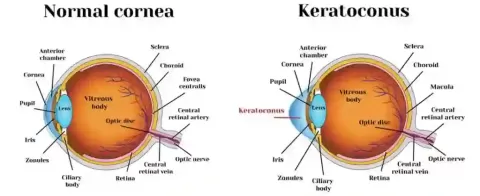
Keratoconus is a progressive condition in which the cornea gradually thins and bulges outward into a cone-like shape, distorting vision. It often develops during adolescence or young adulthood and may progress at different rates from person to person.
Early cases are managed with specially designed contact lenses. A procedure called collagen cross-linking (CXL), which uses UV light and riboflavin drops, can halt progression by stiffening the corneal tissue. Advanced cases may require a corneal transplant.
Conclusion
The cornea is one of the most vital components of the eye. Having an understanding of what the cornea is, its various layers, and some of the diseases associated with it is helpful in recognizing their symptoms and undergoing necessary treatment. Proper eye care and protection of the cornea of the eye are very important to maintain your vision.
Frequently Asked Questions
What Is Cornea in Eye, and What Does It Do?
What Is the Cornea Meaning in Hindi?
How Many Cornea Layers Are Present?
Can a Damaged Cornea Heal Naturally?
Can Screen Time Affect the Cornea of the Eye?

Could not find what you are looking for?


